Square vs. Staggered Setups
If you’re planning a wheel upgrade, square and staggered are the two configurations worth understanding before you decide. A square setup runs identical tires at all four corners. A staggered setup involves fitting wider wheels and tires on a single axle. Each affects handling, traction and long-term costs differently.
Explore square and staggered setups, how each option performs, which works for different drivetrains and what to consider before you commit.
What Is a Square Tire Setup?
A square wheel setup means all four corners run the same tire size, wheel diameter and width.
This is the most common factory configuration. The vast majority of sedans, crossovers, SUVs and trucks leave the assembly line with matching sizes at every corner. Identical sizing simplifies tire management, keeps costs predictable and allows standard rotation patterns that extend tire life.
What Is a Staggered Wheel Setup?
A staggered wheel setup runs wider wheels and tires on one axle, typically the rear, while keeping the diameter the same front to back.
Rolling circumference stays matched, so your speedometer reads accurately, and your ABS and traction control systems don’t register false signals.
Many factory rear-wheel drive (RWD) performance cars ship staggered because engineers place wider rubber where traction demand is highest. Auto enthusiasts building performance-focused vehicles often choose staggered setups for the same reason.
How Square and Staggered Tire Setups Affect Performance
The setup choice has real consequences on the road and track. Traction, handling balance and long-term tire wear all shift depending on which configuration you run.
1. Handling and Cornering Balance
A square setup provides a more neutral handling balance by matching the front and rear grip levels. When the front tires are as wide as the rears, the car stops pushing through corners and starts rotating more evenly, giving a balanced, responsive feel.
Staggered setups intentionally bias the grip toward the rear, which produces understeer by design. The front has less grip than the rear, so the car pushes wide rather than snaps into oversteer, making it more predictable for street driving in a high-powered RWD car.
Track-focused builds almost always favor square setups. A neutral car that rotates evenly through corners is faster at the limit than one engineered to understeer, which is why enthusiasts converting factory-staggered RWD cars for track use frequently switch to square fitment.
2. Traction and Contact Patch
A wider tire changes the shape of the contact patch, creating a broader footprint that can support a stronger grip when paired with the right load, tire pressure and setup.
The traction advantage is specific to where power is delivered. On an RWD platform, wider rears make engineering sense. On a front-wheel-drive (FWD) car, the front tires handle both power delivery and steering, which is why a wider front is the logical choice.
For all-wheel-drive (AWD) platforms, power is split across all four corners, so the traction benefit of a wider rear isn’t as straightforward, and the driveline complications of mismatched rolling diameters often outweigh any traction gain.
3. Tire Rotation and Long-Term Wear
Square setups allow standard front-to-rear tire rotation, which evens out wear patterns. With regular rotation, a square setup yields roughly 32,000-38,000 miles of tire life compared to approximately 25,000 miles with a staggered setup, where the rears wear faster and can’t be swapped to the front.
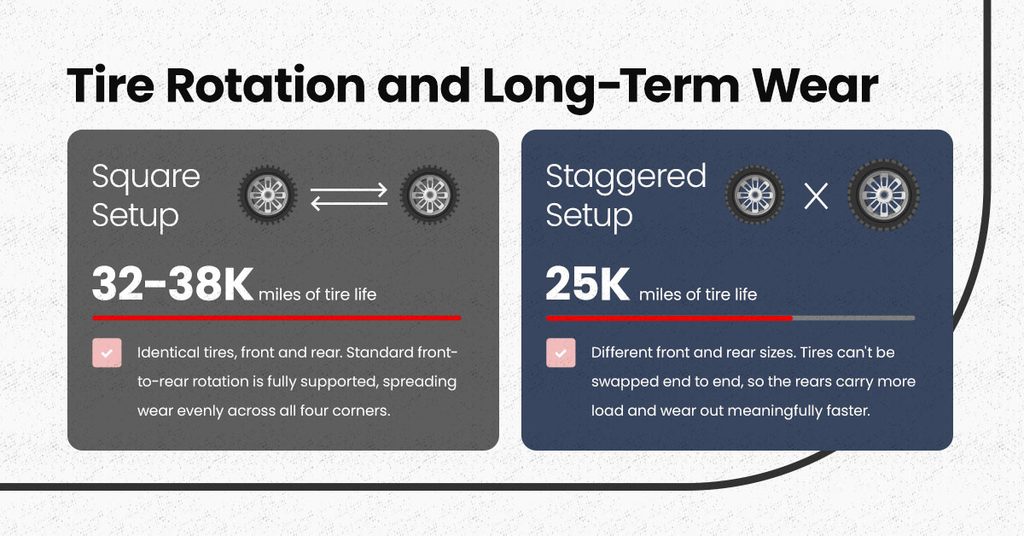
Staggered setups eliminate front-to-rear rotation because front and rear sizes don’t match. That limitation extends to winter, where running a square setup on a dedicated winter wheel package gives you full rotational flexibility and a wider selection of winter tire sizes.
Square or Staggered Setup for Your Drivetrain
The setup choice starts with your drivetrain. How your car puts power to the ground determines which configuration works with your platform and which works against it.
Rear-Wheel Drive and Staggered Setups
On an RWD platform, the rear axle handles both power delivery and weight transfer during acceleration, placing the highest traction demand squarely at the rear. That’s why engineers place the wider tire there.
Staying staggered on a factory-tuned RWD platform also preserves the handling character the chassis was built around. Engineers developed the suspension geometry, alignment specs and overall balance with that rear grip distribution in mind. Changing the setup isn’t just a tire swap.
Going square on a factory-staggered RWD car is a legitimate choice for track-focused drivers chasing a more neutral setup. It requires sourcing a wider front wheel and tire to match the rear, which increases the initial investment and adds unsprung weight to the front axle.
All-Wheel Drive and Square Setups
AWD systems expect front and rear tires to roll at the same rate. When a staggered setup changes the overall rolling diameter between axles, the system treats it as a constant traction event, continuously trying to compensate for a wheel-speed difference that doesn’t reflect actual wheel slip. The result is driveline wear, compromised system response and potentially expensive damage to the transfer case or center differential.
Width and diameter are not the same concern. Running different wheel widths front and rear can work on some AWD systems. What matters is the overall rolling diameter, and that figure must stay matched front to rear.
Front-Wheel Drive and Square Setups
On a FWD car, the front tires handle driving, steering and the majority of braking. That concentration of demand makes square setups the natural choice for FWD.
A staggered setup is almost always a purely aesthetic decision on FWD platforms. Narrowing the front tires reduces grip exactly where the drivetrain needs it most, and no visual payoff justifies that trade-off on a platform where the fronts do all the work.
Square keeps equal rubber at all four corners, supports full tire rotation and delivers the long-term cost advantages that come with even wear across the set.
Pros and Cons of Square vs. Staggered Wheels
Both setups deliver real advantages and come with real costs. Where they land for your build depends on how you drive, what your platform demands and how much long-term tire spend matters to you.
Considerations for a Staggered Setup
For RWD performance builds where rear traction is the priority, the wider rear footprint does real work under power and preserves the handling balance engineers built in from the start. Pros include:
- More rear traction for RWD builds during acceleration and corner exit
- Retains the factory handling character on purpose-built performance platforms
- Achieves an aggressive, planted stance with wider rear tires filling the arches
- Lower initial cost, as narrower front tires are less expensive
The performance advantages come with trade-offs in maintenance, cost and platform compatibility. Consider these cons:
- Standard front-to-rear tire rotation is not possible
- Rear tires wear faster
- Higher long-term tire replacement cost
- Not always suitable for AWD and FWD platforms
- More complex to manage in winter conditions
Considerations for a Square Setup
For any build that isn’t purpose-built around rear traction, square can be the stronger all-around choice. Check out the advantages below:
- More neutral handling balance, with less understeer and better track performance
- Simpler, lower-cost long-term tire management
- Works across all drivetrain types
Most square setup cons show up specifically when converting a factory-staggered platform rather than building square from the start. Potential downsides can include:
- Wider front tires add initial cost and weight when converting from staggered
- Can feel more sensitive on imperfect road surfaces
- Loses the factory handling character of purpose-built staggered platforms
Dial In Your Setup With Rotary
Choosing the right setup is only half the equation. Once you’ve made your call, the quality of the shop work determines whether that decision pays off. Rotary’s professional-grade wheel balancers and advanced wheel aligners give your shop the accuracy to back up every build decision.
Ready to purchase? Contact a local dealer to explore how Rotary upgrades your shop’s wheel service capabilities.
Contact Us
Rotary Solutions has the best, most extensive network in North America to support sales and service of our products in the field. The perfect resource for you is nearby.
Please fill out the form and let us know the specifics of what you need. We appreciate your interest, we’ll get back to you soon, and look forward to following up!