Types of Wheel Balancing: Understanding What Your Shop Needs to Know
Choosing the right wheel-balancing equipment affects how fast your techs move through jobs, how often clients return with the same vibration complaint and whether your shop delivers the kind of service that builds long-term trust. The different types of wheel balancing each serve a distinct purpose, and understanding these differences helps you invest in the right technology for your operation.
Explore the key types of wheel balancing, what sets them apart and how to evaluate which technology makes the most sense for your shop’s goals and bottom line.
Wheel Balancing Methods
The method your shop uses to balance a wheel directly shapes the quality of service your clients experience. The two types of wheel balancing you’ll encounter most often are static and dynamic, though road force balancing has become increasingly common.
Static Balancing
Static balancing corrects an imbalance in a single plane. The process works by allowing gravity to reveal the wheel’s heavy spot, then adding weight to the opposite side to even it out. That means it only addresses the up-and-down “hop.” It doesn’t account for side-to-side “wobble.”
In practice, static balancing is really only suited for older, narrow wheels and may not be accurate for most vehicles on the road today. That said, many modern balancers still include a static mode, which can be useful for certain specialty applications, like motorcycle wheels or narrow trailer tires.
Dynamic Balancing
Dynamic balancing takes a more complete approach. A computerized spin-balancer rotates the wheel and tire assembly at speed while sensors measure imbalance on two planes, both vertical and lateral. The machine’s software then tells the technician exactly how much weight to place and where, on both the inside and outside of the wheel, for a full correction. For the wider, heavier wheels on today’s cars, trucks and SUVs, a two-plane correction is best for achieving a smooth ride and even tire wear.
Road Force Balancing
Road force balancing builds on dynamic balancing by adding a physical simulation of real driving conditions. A large load roller presses against the spinning tire, simulating the vehicle’s weight on the road. This lets the machine analyze how the entire wheel and tire assembly actually behaves under load.
The real advantage is in catching problems that have nothing to do with weight distribution. A tire can be perfectly balanced and still vibrate if it has stiff spots or isn’t perfectly round. A road force machine can tell your technician whether the issue is a weight problem, a tire defect or a bent rim.
Types of Wheel Balancing Machines
Wheel balancers range from simple manual units to fully automated systems, and the key differences come down to how much of the process the machine handles versus the technician.
Manual or Hand Spin Balancers
With a manual balancer, the technician spins the wheel by hand and keys in all the rim data. There’s no motor and no automatic measurement, which keeps the machine small, affordable and easy to maintain. That simplicity is a real advantage for mobile tire operations or shops that only balance a handful of wheels a week.
Semi-Automatic Balancers
When comparing dynamic and static wheel balancing, the key difference is how many planes of imbalance each method corrects. Semi-automatic machines take some of that data entry off the technician’s plate. A data arm or digital caliper automatically reads the rim diameter and offset, though the tech usually still measures width by hand. The spin is motorized, so the process moves faster, and there’s less room for input mistakes.
Fully Automatic Balancers
Fully automatic balancers measure everything on their own. Sonar, laser scanners or 3D imaging systems read the wheel dimensions as soon as the hood closes. Many of these machines also guide the technician to the exact weight placement with a laser.
Features like automatic spoke detection and split weight programs come standard on most models at this level. If your shop is moving a high volume of wheels every day, this route can mean less time per wheel, fewer mistakes, and fewer comebacks.
Light Duty vs. Heavy Duty Balancers
Light duty machines are designed for passenger cars, SUVs and light trucks. They handle standard rim sizes and tire weights without issue, but they’ll hit their limits if you start mounting heavier commercial wheels.
Heavy duty balancers are built for that bigger work. They support larger rim diameters, wider tires and significantly heavier assemblies, which is what you need if your shop services box trucks, buses or other commercial vehicles. The shafts are heavier, the clamping systems are more robust and most include an air lift to help technicians get those wheels on and off the machine safely.
Some shops need both. If you’re primarily a passenger vehicle operation but occasionally take fleet jobs, it’s worth knowing where your current equipment tops out. Trying to balance a heavy commercial wheel on a machine that wasn’t designed for it risks inaccurate results at best and equipment damage at worst.
3 Considerations for Choosing the Best Type of Wheel Balancing Machine for Your Shop
Understanding how wheel balancing connects to the day-to-day realities of running your shop is essential for getting the right machine. Here’s what to evaluate before investing in new equipment.
1. Specialty Wheels
Electric vehicles bring a specific challenge to wheel balancing. They’re heavier than gas-powered vehicles, which amplifies even small imbalances. The quiet operation of EVs means passengers notice vibrations that engine noise would mask in a conventional car.
Shops seeing more EVs in their bays need balancing equipment with the precision to match. The same goes for large-diameter and custom alloy wheels, which require exact weight placement to protect expensive rims and deliver a clean result.
2. OEM Support
Professional installation, thorough staff training and fast access to replacement parts keep your bays productive and your downtime low. When a machine goes down, the speed of your equipment partner’s response directly affects how many vehicles you can turn that day. Look for an OEM that offers hands-on training and stocks parts domestically so your team stays confident on the equipment and your shop stays productive.
3. Balancer ROI
It’s important to calculate the return on investment (ROI) based on your shop’s specific numbers. For most shop owners, the real question about a new balancer is what the machine delivers over time. A faster, more accurate balancer means less labor time per vehicle, fewer comebacks and the ability to charge for premium services like road force balancing. This way, the investment starts to pay for itself through the revenue it generates and the costs it removes.
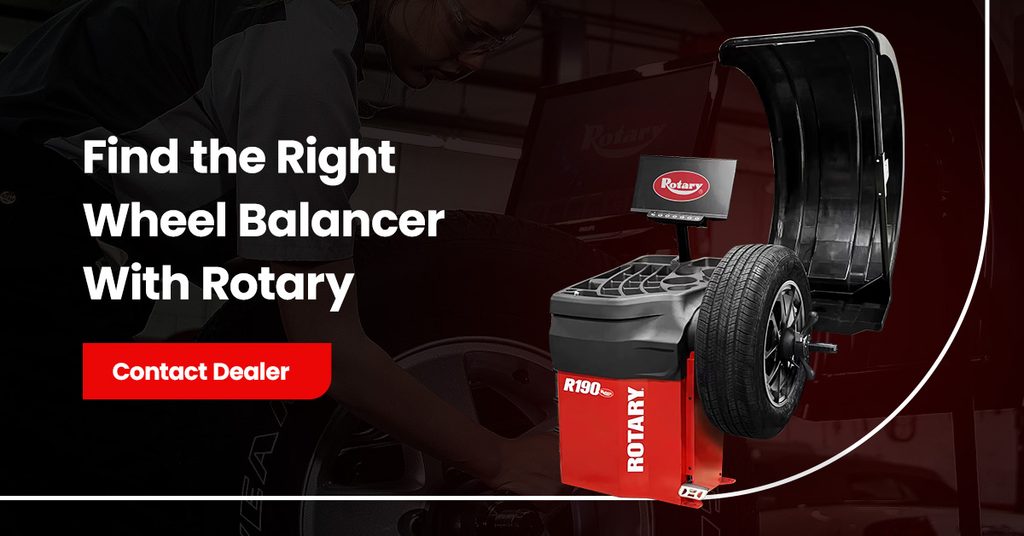
Find the Right Wheel Balancer With Rotary
The wheel balancing technology in your shop has a direct impact on your reputation, efficiency and profitability. Whether you’re adding balancing services for the first time or upgrading your current setup, Rotary offers a full range of machines, from value-focused models to advanced laser-scanning systems, designed to match the needs of your operation.
Ready to purchase? Check out Rotary’s full lineup of wheel balancers to find the right fit for your shop, and contact a dealer today.
Contact Us
Rotary Solutions has the best, most extensive network in North America to support sales and service of our products in the field. The perfect resource for you is nearby.
Please fill out the form and let us know the specifics of what you need. We appreciate your interest, we’ll get back to you soon, and look forward to following up!